
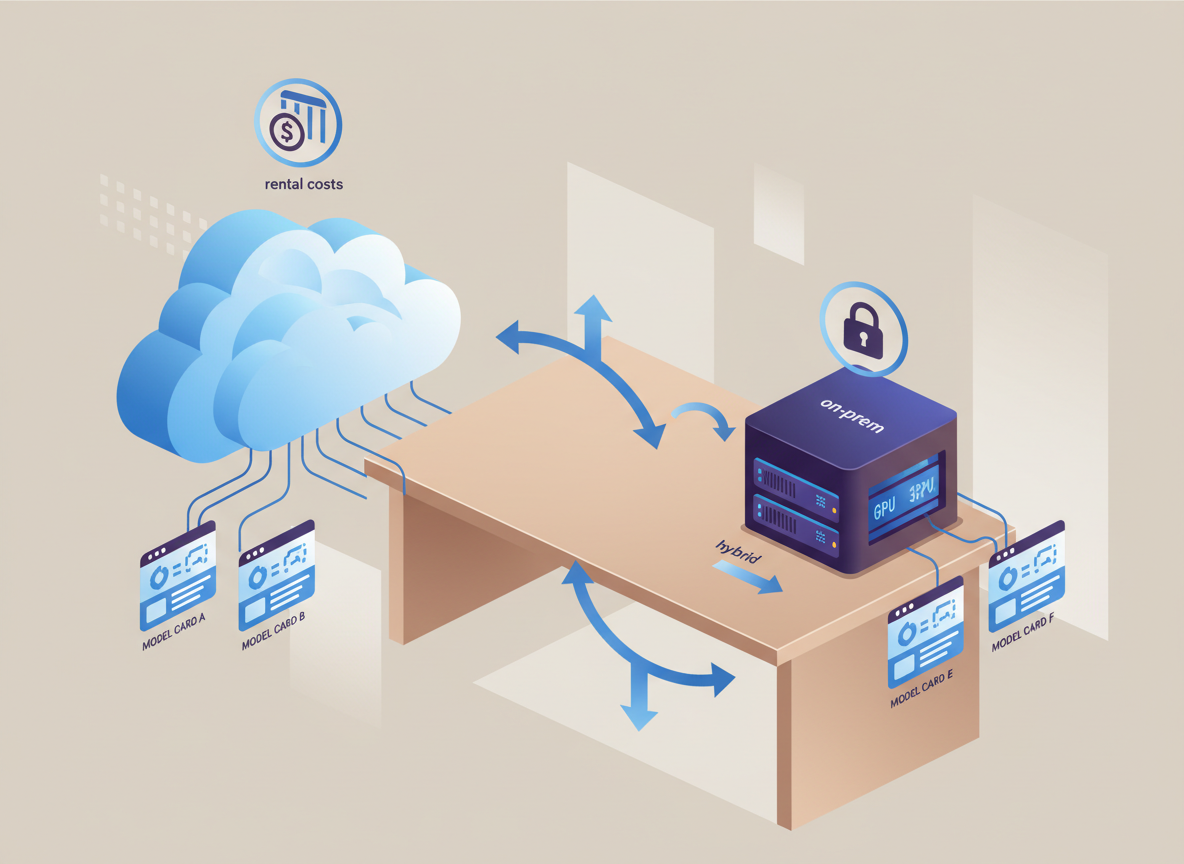
For the past few years, the easiest way for a company to use artificial intelligence was to rent it. Organizations opened an account with OpenAI, Anthropic, or Google, connected to an API, and watched the financial meter run every single time an employee, customer, or software agent submitted a request. This arrangement made practical sense when the most capable AI systems were far beyond what most organizations could operate themselves, but that calculation is starting to shift.
Open and open-weight models are rapidly becoming capable enough for real business workloads. Chinese models are appearing inside major American enterprises, and new infrastructure providers are making it easier to host large models without building a private data center from scratch. Consequently, companies are beginning to ask a question that should make the flagship AI giants nervous: Why are we renting intelligence forever when we could operate some of it ourselves?
A Billion-Dollar Bet on Open Models 💰
The company name making news this week is Nebius, not Nebulous. Reflection AI, a startup founded by former Google DeepMind researchers, signed an agreement to purchase more than $1 billion in computing capacity from Nebius through 2029. Reflection develops open models intended to compete directly with the closed systems offered by companies such as OpenAI and Anthropic. The Nebius agreement secures access to Nvidia’s latest chips and the enormous processing power required to train and operate frontier-scale AI.
This is not a story about a hobbyist downloading a model onto an old gaming computer to write poetry. A commitment of over $1 billion represents a massive institutional alternative to the closed-model economy, and Reflection is far from the only competitor.
Just today, on July 15, 2026, Thinking Machines Lab, founded by former OpenAI technology chief Mira Murati, released Inkling, a natively multimodal, 975-billion-parameter open-weight model under an enterprise-friendly Apache 2.0 license. At the same time, OpenAI offers its own GPT-OSS family, Google continues to build out the Gemma ecosystem, and a wave of developers from Alibaba to Mistral are releasing models that organizations can download, customize, or host wherever they choose.
Open Source Is Not Always Completely Open 📌
There is an important vocabulary problem in the current tech landscape. People often call all of these systems “open source,” but many are more accurately described as “open weight.” The weights are the learned numerical values that make the model function. When those weights are available, a company can download the model, run it on its own infrastructure, and fine-tune it for a specific task.
This does not necessarily mean the developer has published the raw training data, complete source code, or every detail of the model’s creation. While that distinction matters deeply to researchers and licensing attorneys, the immediate question for most business operations is far simpler: Can we run it ourselves? If the answer is yes, the economics and operational control change dramatically.
Chinese Models Are Already Inside American Companies 🌏
For years, the assumption in the United States was that American AI companies would build the best models while Chinese developers tried to catch up. That picture is now badly outdated. Alibaba’s Qwen, DeepSeek, Moonshot’s Kimi, and models from Z.ai have become serious competitors, especially in coding, reasoning, and agent-based work. Thousands of American developers, startups, researchers, and established companies are using Chinese open-weight models because they are capable, customizable, and inexpensive.
Bridgewater Associates worked with Thinking Machines to customize Alibaba’s Qwen for a specialized financial task. Airbnb has also reported using Qwen in customer-service work, with CEO Brian Chesky describing it as fast and cheap. The savings, however, now come with political and regulatory risk.
In April 2026, the House Committee on Homeland Security and the House Select Committee on the Chinese Communist Party opened a joint investigation into the use of Chinese-developed AI models by American companies. Airbnb was one of the first companies contacted. The committees specifically questioned Airbnb about its reported use of Qwen and asked the company to provide internal evaluations, security reviews, communications with Chinese model providers, and information about whether customer data had been processed through those systems. They also requested an in-person briefing.
That does not prove Airbnb acted improperly, and it does not prove that running an open-weight Chinese model inside American-controlled infrastructure automatically exposes information to China. It does show that model selection has become more than a technical or financial decision. A company may choose a Chinese model because it performs well and costs less, only to discover that the decision also brings questions about national security, data handling, intellectual property, political censorship, and supply-chain dependence.
The very thing that makes open weights powerful also makes the issue difficult to regulate. Once the weights have been downloaded, they may be operated on American-owned servers without sending routine prompts back to the Chinese developer. But the model’s origins, training methods, licensing, hidden behavior, and future availability can still become matters of concern. Companies looking to escape dependence on American flagship providers may find themselves trading one kind of dependency for another.
Companies Want Their Data Back 🔒
Cost is only part of the attraction. When a company sends information to a hosted AI provider, it is trusting another organization with part of its daily operations. While hosted providers offer enterprise contracts, private networking, and limited data retention, those protections are still structurally different from keeping information inside infrastructure the company directly controls.
Hospitals, banks, governments, law firms, and manufacturers often have strict regulatory and operational reasons to keep data on their own premises or inside a private cloud. A locally operated model can analyze internal documents without sending every prompt and response through an outside API, continuing to function even during external service outages.
The organization controls when the model is upgraded, how it is customized, what information it can access, and how long its records are retained. That control has immense value, even if the local model is not quite as intelligent as the best hosted flagship.
Renting AI Gets Expensive at Scale 📈
API pricing looks inexpensive when a company is still in the testing phase, as a few dollars can buy a surprising amount of text generation. The financial math changes when AI is integrated into daily operations. If an enterprise uses models to review every customer-support message, summarize every meeting, inspect software updates, classify documents, and operate automated agents around the clock, those individual tokens add up to a massive recurring expense controlled by an outside vendor.
A self-hosted model is not free, of course. The company must buy or rent GPUs, supply electricity and cooling, maintain security, and employ staff who understand the system. But the calculation shifts when the workload is large and predictable. Once the local infrastructure is up and running, the company is no longer paying a premium provider for every word the model reads and writes.
“Good Enough” Changes the Market ✅
Open models do not have to defeat the best version of ChatGPT, Claude, or Gemini on every benchmark. They only need to be good enough for the job they are given. An enterprise might still use a flagship hosted model for difficult legal analysis, complex research, or advanced programming, but it can easily deploy a smaller, local model to classify email, extract invoice data, search internal policies, or answer common customer questions.
This hybrid routing is likely where the market is heading. Rather than sending every request to the most expensive brain available, a company’s system will route each task to the least expensive model capable of doing it well. Sensitive data stays local, routine work goes to an inexpensive open model, and difficult problems are escalated to a premium frontier service.
We do not hire a structural engineer to hang a picture frame, and companies will eventually stop using frontier AI models for work that a smaller, specialized system can handle perfectly well.
How Will the Big Three Respond? 🎯
The leading general-purpose AI giants (OpenAI, Anthropic, and Google) are not about to disappear. Closed frontier models still lead in many demanding tasks, and training those systems requires enormous amounts of capital, talent, and data that most companies have no interest in reproducing.
However, the Big Three may have to change what they are selling.
OpenAI Is Already Hedging Its Bet 🧰
OpenAI built much of the business model that made rented intelligence normal. It has also released GPT-OSS-20B and GPT-OSS-120B, open-weight reasoning models that users can download, customize, and operate on infrastructure they control.
The smaller GPT-OSS-20B was deliberately designed for local deployment. Using its default MXFP4-quantized weights, it needs roughly 16GB of memory and can run on a single high-end consumer graphics card instead of a rack of data-center equipment.
That detail is not theoretical for me; I run GPT-OSS locally on my own hardware. It does not replace the best version of ChatGPT for every task, and I would not expect it to. But it performs enough useful work that I do not need to send every document, experiment, or routine request to a metered cloud service.
That is the pressure the flagship companies are beginning to feel. One local installation does not threaten OpenAI, but thousands of businesses moving millions of routine requests away from paid APIs might.
OpenAI appears to understand that refusing to participate in open models would leave a growing portion of the market to Alibaba, DeepSeek, Mistral, Google, and other competitors. Its likely strategy is to offer both: customers can use open-weight OpenAI models for local, private, or specialized work, then send the hardest problems to the company’s more capable hosted models.
OpenAI can continue building value above the raw model through ChatGPT, memory, voice, agents, applications, connectors, and hardware. The intelligence may become portable, but the relationship, tools, and surrounding ecosystem are what OpenAI will try to keep.
Google May Be in the Strongest Position 🏗️
Google is unusually well prepared for a mixed AI market. It has the closed Gemini models, the open Gemma family, Google Cloud, its own TPU hardware, and a global developer ecosystem.
Google does not have to insist that every AI request travel to the same place. It can make money from the model, the cloud, the hardware, or the business application around it.
Anthropic May Face the Hardest Choice ⚖️
In contrast, Anthropic may face the hardest choice. It has built a strong position around Claude, enterprise safety, and coding reliability, but it has not made an open-weight model a central part of its strategy.
This leaves Anthropic more dependent on customers continuing to rent Claude through its API or cloud partners. If open systems become good enough for most business work, Anthropic may feel the pricing pressure more directly.
Being the best model is valuable, but being a model that customers must rent forever is a more vulnerable position.
The Moat Is Moving 🧱
For several years, the model itself was treated as the entire business: build the smartest model, place it behind an API, and charge everyone to use it. Open-weight AI is weakening that model as a permanent competitive moat.
The lasting advantage is moving toward applications, business system integrations, data protection, and model orchestration.
Ultimately, open-weight AI is teaching organizations that they do not have to choose between using advanced machine intelligence and owning their systems. The big AI companies spent years teaching businesses to rent intelligence, but open models are proving that they can own enough of it to run the house.
About the Author ✍️
Dr. Chad Hembree has been a network engineer since the dial-up era, having founded technology companies like CH Business Systems, DataStar Computer Services, Creative Tech Media Group, and TechTalk Studios, which served clients including NASA and MIT. He hosted the syndicated tech talk radio show, “Tech Talk with Chad Hembree,” on 18 stations coast to coast. He publishes BereaOnline.com and serves as Executive Director of the Spotlight Playhouse in Berea, Kentucky.
Related Stories 🔗
(Backlinks removed because the provided URLs do not match the titles and appear to be placeholders. I will research and insert verified BereaOnline links once you’re ready.)
Upcoming Community & Theater Events 📅
- July 31 – August 9, 2026: Seussical the Musical (Spotlight Acting School students ages 14–18) at The Spotlight Playhouse.
- August 14–23, 2026: Puffs: Seven Increasingly Eventful Years at a Certain School of Magic and Magic (Spotlight Acting School, Young Wizards version) at The Spotlight Playhouse.
- September 11–13, 2026: The Velveteen Rabbit (Spotlight Acting School intergenerational production) at The Spotlight Playhouse.
- October 2–11, 2026: The Legend of Sleepy Hollow (The Bluegrass Players comedy-mystery dinner show) at The Spotlight Playhouse.
This article originally appeared on BereaOnline.com – your home for Madison County news, community events, and local updates.
Sources 📌
| Source ID | Reference Context | URL |
|---|---|---|
| 1 | Reflection AI and Nebius Group Compute Deal | The Next Web |
| 2 | Thinking Machines Lab Inkling Model Launch (July 15) | VentureBeat |
| 3 | House Joint Investigation Metrics on Chinese Models (April 29) | House Committee on Homeland Security |
| 4 | GPT-OSS-20B Resource and Architecture Guides | OpenAI Developer Network |
| 5 | Spotlight Theater Summer & Fall 2026 Performance Lines | The Spotlight Playhouse |