
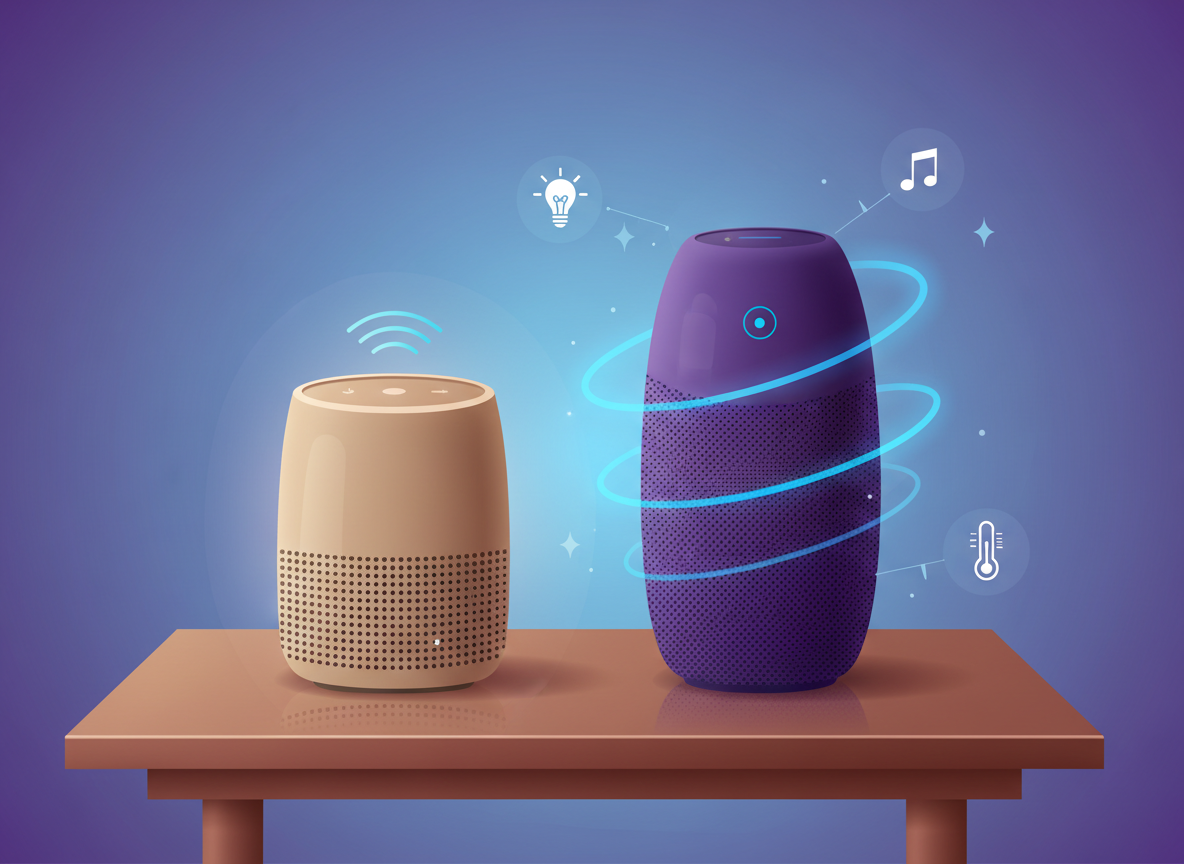
OpenAI is reportedly working on a portable, screenless smart speaker designed to bring ChatGPT out of the browser and into the home. The device is being developed with the hardware team led by former Apple designer Jony Ive. Reports describe a rechargeable speaker with cameras, environmental sensors, moving mechanical parts, and a more expressive personality than the stationary smart speakers we have grown used to. The expected price is somewhere around $200 to $300, with a possible launch in 2027.
That is interesting, but the hardware is not the question that matters most to me. I am already deeply integrated into Amazon’s ecosystem. Alexa controls devices throughout my home. It plays my music, manages timers, handles simple household requests, and connects to services and equipment I have collected over years. I do not use Alexa because I think it is intelligent; I use it because it knows where the light switches are. For anything that requires real thought, research, writing, planning, or a useful conversation, I go to OpenAI. So now we may be looking at a joining of forces. OpenAI wants to bring its intelligence into the same physical space where Alexa already handles the plumbing. The question is whether that would be enough to make someone like me switch.
What OpenAI Is Reportedly Building 🧩
OpenAI has officially confirmed that Jony Ive’s hardware team joined the company to develop a new generation of AI devices. The details of the speaker itself still come from reporting rather than a formal product launch, so much could change before it reaches stores.
The device is reportedly designed as a portable, screenless companion rather than a traditional speaker that stays plugged into one room. It may include a rechargeable battery, cameras and environmental sensors, moving physical components intended to give it personality, smart-home controls, music and media playback, messaging tools, and access to ChatGPT’s broader research capabilities.
The suggested $200 to $300 price would place it well above an inexpensive Echo Dot. OpenAI does not appear to be trying to win by putting a cheap microphone in every room. It appears to be building a premium AI companion. That distinction matters.
OpenAI Has the Brain 🧠
OpenAI’s current GPT-Live technology shows that it may already have the conversational brain Amazon has struggled to deliver. ChatGPT can hold a real conversation. It can understand a complicated request, ask useful follow-up questions, explain its reasoning, search for information, work with documents, help plan projects, and remember relevant context.
Alexa can turn off a light, but ChatGPT can help me work out whether the light should still be on.
That difference becomes important when a household request involves more than one command. Imagine saying: “We are leaving Spotlight for the night. Check tomorrow’s schedule, make sure nobody is still in the building, turn off everything except the emergency and perimeter lights, adjust the thermostats, and remind me if the refrigerator door is still open.”
Alexa is capable of performing some of those individual actions if each one has been configured in advance. ChatGPT is capable of understanding the whole situation.
That is what makes the idea of an OpenAI home device compelling. It could become more than another voice-controlled switchboard. It could understand intent, combine information from several systems, and help manage the larger task.
But understanding the task is only half the job. The device still has to know where the light switches are.
The Voice May Be the Real Product 🎙️
The most important technology inside OpenAI’s speaker may not be the speaker at all. Earlier this month, OpenAI introduced GPT-Live, a new generation of conversational voice models that now powers ChatGPT Voice.
Unlike older assistants that wait for a person to finish speaking before processing a command, GPT-Live is designed for full-duplex conversation. It can listen and speak at the same time, follow interruptions, notice pauses, and decide whether to respond or continue listening.
That sounds like a technical detail until you compare it with the way most people speak to Alexa. Alexa conversations are usually a series of carefully formed commands. We learn which words work, pause at the right moment, and wait for the system to respond.
GPT-Live points toward something more natural. A person could interrupt, change directions halfway through a request, add context, or pause to think without the speaker assuming the conversation is finished.
OpenAI has not confirmed that GPT-Live will be the final voice engine inside this device. The speaker itself has not been formally announced. Still, GPT-Live provides the clearest preview of what OpenAI is trying to build: not merely a smart speaker that accepts commands, but an assistant that can remain inside a flowing conversation while more powerful models handle complicated work behind the scenes.
That could be the feature that separates it from Alexa.
The danger is that OpenAI could become so focused on making conversation feel human that it forgets a household assistant also has to be fast, predictable, and quiet when the job is simple. Sometimes I want a conversation. Sometimes I just want the kitchen light turned off.
Amazon Already Owns the Plumbing 🧰
Alexa works in my house because Amazon spent years building an ecosystem around it. It connects to lights, plugs, cameras, thermostats, speakers, music services, shopping lists, routines, doorbells, televisions, and thousands of other products.
More importantly, I have already done the work. The devices have names. The rooms are configured. The groups exist. The routines are built. My music accounts are connected. The household knows which phrases work.
That investment matters. OpenAI cannot expect people to throw away years of setup simply because its speaker gives better answers. If I buy an OpenAI speaker and have to recreate every room, rename every device, rebuild every routine, reconnect every service, and replace working equipment, the answer is probably no.
Intelligence alone is not enough to overcome ecosystem gravity.
What OpenAI Would Have to Do ✅
For someone like me to switch, OpenAI would need to treat compatibility as a central product feature rather than an afterthought.
- Control Existing Devices: Strong Matter and Thread support would be essential. The speaker would need to work with existing lights, plugs, thermostats, cameras, doorbells, and other equipment without requiring one preferred brand. Ideally, it would also connect directly to Alexa routines or import an existing Amazon smart-home configuration. OpenAI should not make users rebuild the house to use a smarter assistant.
- Keep Simple Commands Simple: A household assistant cannot overthink everything. When I say, “Turn on the kitchen light,” I do not need a discussion about lighting preferences or a thoughtful explanation of electricity. I need the kitchen light to turn on. Quick household commands must be local, fast, and reliable. The advanced reasoning should appear when the request actually requires it. The smartest assistant in the world becomes irritating very quickly if it takes eight seconds to set a timer.
- Support Current Services: For me, music matters. OpenAI would need strong support for Amazon Music, Audible, Spotify, podcasts, multi-room audio, and other common services. It cannot launch with two preferred streaming partners and tell everyone else to wait. The same applies to calendars, messaging platforms, shopping lists, security systems, and home cameras. A useful home assistant is mostly integrations held together by voice.
- Real Household Profiles: A shared speaker cannot treat everyone in the room as the same person. It would need reliable voice recognition, separate memories, individual calendars, separate music preferences, parental controls, guest access, private conversations, and purchasing permissions. My ChatGPT history should not shape the answers given to another member of my household unless we deliberately share that information. That is not a small feature. It may be one of the hardest parts of building the product.
The Camera Could Be Useful, Not Just Creepy 📷
A screenless AI device with cameras and environmental sensors will immediately raise privacy concerns. OpenAI would need to provide a physical camera shutter, a physical microphone disconnect, obvious recording indicators, clear controls over stored information, an audio-only mode, local wake-word detection, and a plain explanation of when audio or video leaves the house.
A software privacy setting is not enough when the device is physically watching the room. People need to be able to look at the speaker and know the camera is blocked.
However, the reported camera and environmental sensors could give the device abilities Alexa does not have. It might recognize who is speaking, understand what object someone is referring to, notice that a package has arrived, identify what is making a sound, or help a person work through a physical task.
A user could point toward a device and ask why it is not working. The assistant might see the indicator lights, identify the model, and walk the user through troubleshooting.
In a kitchen, it might help identify ingredients or track a recipe. In an office, it could understand a whiteboard or document. In a theater, it might help identify equipment, monitor a room, or guide a technical task.
That could be genuinely useful. It also creates enormous privacy responsibility. The camera is either one of the product’s biggest advantages or the reason people refuse to put it in their homes.
OpenAI will have to earn trust before asking customers to accept an intelligent camera that can see and interpret their surroundings.
It Needs More Than One Device 🏠
A $250 speaker may make sense in a living room or office. It does not make sense as the only option for every bedroom, hallway, kitchen, workshop, and theater space.
Amazon built Alexa’s household presence partly by selling inexpensive Echo devices that could be scattered everywhere. OpenAI will eventually need cheaper satellite speakers, compatibility with existing audio equipment, or a family of devices at several price points. Otherwise, it will be an excellent ChatGPT terminal in one room, not a household platform.
The subscription model could also decide the product’s future. OpenAI has not announced what plans will be required, but a $250 speaker followed by a mandatory monthly subscription would be a difficult sale.
Existing ChatGPT Plus and Pro subscriptions should carry over. Basic smart-home controls, timers, music, and household functions should be included with the device. Premium reasoning or heavier agent use could remain part of higher subscription tiers. Nobody should need an expensive AI plan to turn off a lamp.
Apple May Have Something to Say About the Launch ⚖️
OpenAI’s hardware plans also face a new and potentially serious complication. Apple filed a federal lawsuit against OpenAI, its hardware subsidiary io Products, and two former Apple employees on July 10. Apple alleges that OpenAI benefited from confidential information involving unreleased hardware, manufacturing processes, suppliers, and product development.
OpenAI denies having any interest in Apple’s trade secrets. The lawsuit seeks damages and court orders intended to prevent the use of information Apple claims was improperly obtained. No judge has halted the speaker project, and Apple’s allegations have not been proven.
Still, a trade-secret dispute involving the hardware team could create delays, force design or manufacturing changes, and expose parts of OpenAI’s development process through the legal discovery process.
The timing is difficult to ignore. The lawsuit arrived only days before reports identified the portable speaker as OpenAI’s likely first consumer device.
This does not mean the reported 2027 launch is dead. Technology companies routinely continue developing products while major lawsuits move through court. It does mean that OpenAI’s road into consumer hardware may be more complicated than hiring former Apple designers and building an elegant object.
OpenAI is trying to enter a business Apple understands extremely well: turning advanced technology, industrial design, manufacturing, services, and customer loyalty into one tightly controlled product. Apple appears prepared to defend that territory.
OpenAI Should Not Try to Destroy Alexa 🤝
The smartest strategy may be cooperation rather than replacement. OpenAI does not need to manufacture every light bulb, camera, thermostat, and music service. It needs to become the intelligence layer that can work through the systems people already have.
Let Alexa, Matter, Google Home, Apple Home, Home Assistant, and other platforms continue handling device communication. Let ChatGPT understand the larger request and decide which tools to use.
That would give users the best of both worlds. Alexa could remain the dependable household plumbing, while OpenAI could become the brain coordinating it.
This would also make switching less important. People could add an OpenAI device without throwing away working equipment, then gradually decide which assistant they prefer for different tasks.
That is how I would use it at first. I would not remove Alexa on launch day. I would place the OpenAI speaker alongside it and see whether ChatGPT could manage the complicated household requests Alexa never understood. If it worked, the balance might slowly shift.
What Would Make Me Buy It? 🧾
I would seriously consider buying the first OpenAI speaker if it offered full access to the ChatGPT account and memory I already use, reliable control of my existing smart-home equipment, Amazon Music and Audible support, fast local handling of simple commands, strong household profiles, and physical privacy controls like a camera shutter.
I do not need another device that can tell me the weather. I am interested in a device that understands the context of my day, works with the systems already around me, and helps complete real tasks. That is the opportunity.
For users like me, the winner will not be the assistant with the highest benchmark score. It will be the one that combines real intelligence with the systems already running the house. OpenAI may have built the brain Alexa never had. The question is whether it can inherit the house Alexa already controls.
About the Author ✍️
Dr. Chad Hembree has been a network engineer since the dial-up era, having founded technology companies like CH Business Systems, DataStar Computer Services, Creative Tech Media Group, and TechTalk Studios, which served clients including NASA and MIT. He hosted the syndicated tech talk radio show, “Tech Talk with Chad Hembree,” on 18 stations coast to coast. He publishes BereaOnline.com and serves as Executive Director of the Spotlight Playhouse in Berea, Kentucky.
Related Stories 🔗
- Why Amazon Says Human-in-the-Loop AI Oversight Is Failing
- We Can Gate the Danger in AI Without Gating the Benefit
- Sometimes the Fix Is a Face-to-Face Conversation
Upcoming Community & Theater Events 📅
- July 31 – August 9, 2026: Seussical the Musical (Spotlight Acting School students ages 14–18) at The Spotlight Playhouse.
- August 14–23, 2026: Puffs: Seven Increasingly Eventful Years at a Certain School of Magic and Magic (Spotlight Acting School, Young Wizards version) at The Spotlight Playhouse.
- September 11–13, 2026: The Velveteen Rabbit (Spotlight Acting School intergenerational production) at The Spotlight Playhouse.
- October 2–11, 2026: The Legend of Sleepy Hollow (The Bluegrass Players comedy-mystery dinner show) at The Spotlight Playhouse.
This article originally appeared on BereaOnline.com – your home for Madison County news, community events, and local updates.
Sources 📌
| Source ID | Reference Context | URL |
|---|---|---|
| 1 | Full-Duplex Voice Engine Architectures | OpenAI Blog |
| 2 | Portable Smart Speaker Hardware Leak | Bloomberg |
| 3 | Apple Inc. v. OpenAI Inc. Trade Secret Filings | CourtListener |
| 4 | Spotlight Playhouse Summer & Fall 2026 Performance Lines | The Spotlight Playhouse |