
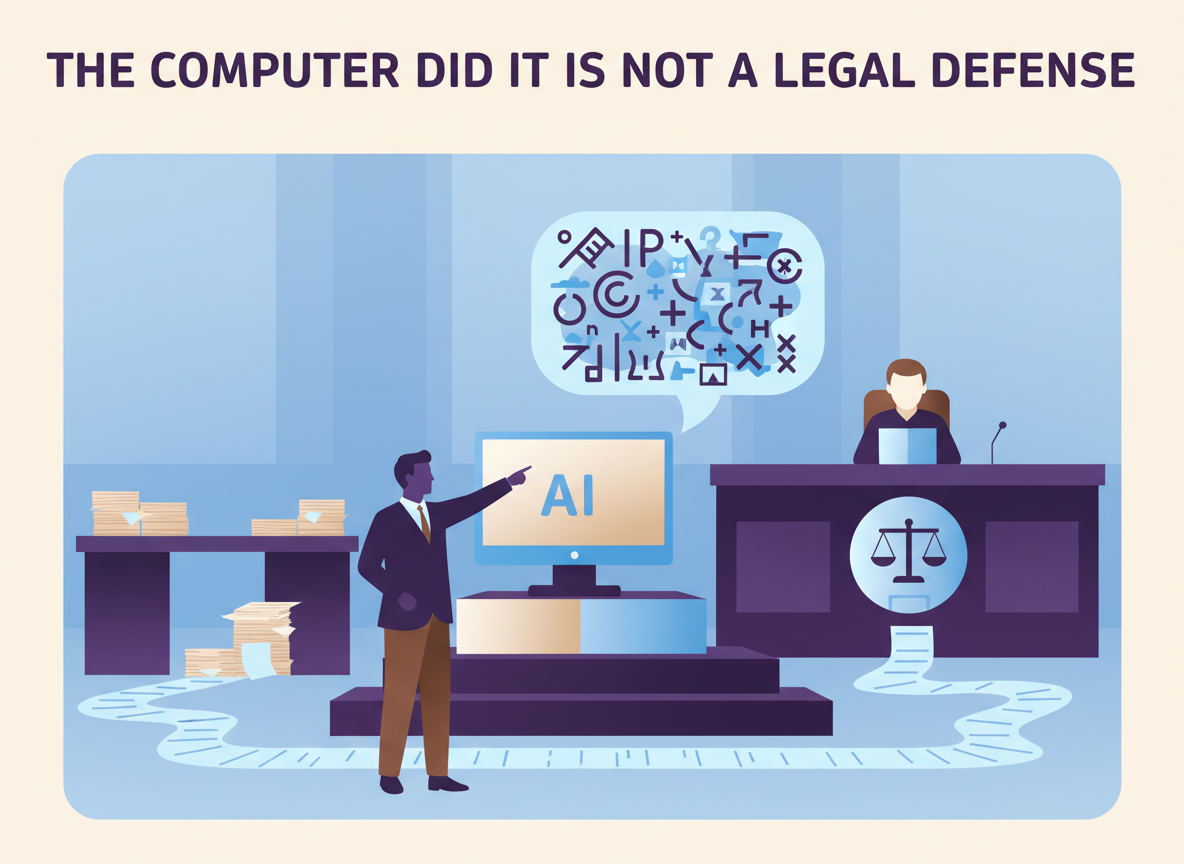
I have spent enough years around computers to recognize one of the oldest excuses in technology: the computer did it. If a customer was billed incorrectly, an application was rejected, or an employee received an unfavorable score, the blame was routinely shifted to the software. That explanation was never especially convincing, but generative artificial intelligence has made it far more tempting for corporate leadership. AI systems are intensely complicated, their internal decision-making paths can be difficult to explain, and even the companies operating them may not always know exactly why a particular result appeared. That lack of transparency does not mean nobody is responsible.
A new wave of lawsuits and regulatory actions involving Meta and Google is beginning to test that principle from several directions. At Meta, employees allege that AI-assisted productivity measurements helped select workers for layoffs while penalizing people who were legally absent on medical, parental, or family leave. In Germany, regulators and courts are telling Google that when its AI writes a false summary, the company cannot simply hide behind the immunities traditionally granted to search engines displaying third-party content. Meanwhile, publishers and authors are suing both Google and Meta over allegations that copyrighted books and articles were copied without permission to train Gemini and Llama. While these are entirely different cases involving separate legal frameworks, they all raise the same basic question: When AI makes the decision, writes the accusation, or consumes the book, who owns the consequences?
Meta Employees Say AI Turned Leave Into Low Productivity 📊
Twenty-six Meta employees filed a lawsuit in federal court in California on July 13, 2026, alleging that a constellation of internal artificial intelligence systems and automated productivity measurements helped determine who would be selected for the company’s latest round of mass layoffs. The workers say Meta considered automated signals such as activity monitoring, keystroke logging, code contributions, and AI token-usage dashboards. That data pipeline becomes a serious legal vulnerability when an employee is absent due to protected leave.
Someone recovering from surgery will naturally produce fewer code updates, an employee on parental leave will register zero keyboard activity, and a worker dealing with a disability may utilize fewer internal developer tools while receiving an approved workplace accommodation. According to the complaint, Meta’s automated systems did not properly adjust for those circumstances, meaning employees who exercised their legal right to leave appeared significantly less productive than colleagues who worked continuously.
The plaintiffs were selected for termination but remained employed when the lawsuit was filed, with their official separations scheduled to begin on July 22, 2026. They are asking the court to halt the terminations while the dispute proceeds and to mandate an independent technical audit of the evaluation systems. Meta denies the allegations, stating that human managers, not automated models, made its workforce decisions.
That distinction will matter in court, but it does not settle the larger operational issue. A human manager clicking a final approval button does not make an automated ranking system irrelevant.
If an algorithm structured the metrics, identified the supposed low performers, or isolated the list of employees under consideration, the technology shaped the termination before a human executive ever reviewed it. The core question is whether the enterprise relied on a system that treated legally protected absences as evidence of poor performance.
Protected Leave Is Not Immunity From Layoffs 🏥
There is an important legal distinction to maintain here. An employee on medical or family leave is not automatically immune from a company-wide workforce reduction. A business can eliminate a position for legitimate economic reasons even when the person holding that position happens to be away from the office. What an employer cannot do under federal guidelines is utilize protected leave as a negative performance factor.
The difference sounds simple until an automated productivity dashboard enters the room. A traditional human supervisor understands that an employee’s output was lower because the individual spent two months recovering from a medical procedure. In contrast, an algorithmic tracking tool simply logs an empty space representing fewer completed tasks, fewer messages, and fewer hours of active digital signatures.
The machine records a productivity drop, while the law sees an employee exercising a protected right. That is the danger of converting complex human circumstances into raw numerical scores. Numbers can look neutral while quietly carrying every bias, omission, and bad operational assumption built into the code.
Germany Says an AI Answer Belongs to the Company That Generated It 🇩🇪
Google is facing a different structural challenge regarding automated outputs in Europe. Two German publishers took Google to court after AI Overviews allegedly connected their brands with fraudulent digital scams. A Munich court concluded that the AI-generated summaries could be treated as Google’s own original assertions rather than a neutral display of third-party data, a decision Google plans to appeal.
Germany’s media regulators have now pushed that liability logic even further. On July 14, 2026, the Commission for Licensing and Supervision, known as ZAK, declared that generative services such as Google AI Overviews and Perplexity must be treated as content providers under national media law. For decades, search engines and internet platforms have argued that they are primarily conduits, helping users locate information created by other people without endorsing or authoring the underlying text.
Generative AI completely rewrites that relationship. An AI Overview does not simply display a list of external links and let the reader navigate the context. It selects data, synthesizes it, rewrites it, and presents a brand-new narrative under Google’s own banner.
The regulatory position in Germany is clear: once the machine authors the answer, it becomes the corporation’s answer. The historical defense of functioning as a passive intermediary becomes impossible to maintain when the search platform stops pointing toward outside speech and begins speaking on its own authority.
The Battle Over Training Data Acquisition 📚
On July 10, 2026, Hachette Book Group, Cengage Learning, Elsevier, and author Scott Turow filed a proposed class-action lawsuit against Google in federal court in New York, accusing the company of copying millions of copyrighted books and journal articles without permission to train its Gemini model suite. The complaint raises questions that go well beyond the standard legal arguments over general web scraping.
The publishers allege that Google recycled books and scholarly publications it already possessed through consumer programs like Google Books, Google Play Books, and Google Scholar. Those materials were originally provided to Google under highly restrictive, limited-purpose licenses for retail sales, search previews, or academic indexing. The publishers argue that permission to host an e-book for retail sale does not constitute a blanket license to feed that intellectual property into a commercial machine-learning model.
Meta faces a similar copyright challenge with an even sharper focus on data provenance. A separate publisher lawsuit filed in May 2026 alleges that Meta utilized BitTorrent networks to download massive blocks of copyrighted text from known piracy hubs and shadow libraries. Because the BitTorrent protocol inherently involves simultaneous uploading and downloading across users, the complaint alleges that Meta actively distributed copyrighted works while acquiring its training datasets.
While AI laboratories frequently defend model training as a transformative process permitted under fair use guidelines, transformation and acquisition are two entirely separate legal questions. A tech firm might have a viable fair use defense regarding how its model processes language patterns, yet still face severe liability for how it acquired the underlying source material.
Building a new structure is transformative, but that transformation does not legitimize utilizing stolen lumber to build the foundation.
These Cases Are About Delegated Power 🧩
The Meta employment lawsuit, the German media decisions, and the copyright cases appear unrelated at first. One concerns workers. One concerns false statements. One concerns books. What connects them is delegated power.
Companies have always delegated authority. They delegate decisions to supervisors, accountants, contractors, publishers, and outside vendors. The law has never generally allowed a company to accept the benefits of that work while automatically escaping responsibility for the harm it causes. Artificial intelligence does not change that basic principle.
AI systems are not employees in the traditional legal sense, and courts have not simply declared algorithms to be corporate agents. The more direct rule is that a company remains responsible for the systems it selects, configures, supplies with data, and places into operation. Meta allegedly used automated measurements and rankings as part of its workforce process. Google chose to place AI-generated summaries above traditional search results and present them to the public. Google and Meta decided how training material would be gathered, copied, processed, and used to build commercial models.
In each case, the company controlled the deployment and received the benefit. That is why blaming the machine is unlikely to settle the question. A business cannot market AI as powerful enough to evaluate workers, answer questions, create publications, and build valuable products, then describe it as an independent mystery when the output creates legal trouble.
The company selected the system. The company determined its purpose. The company established the process around it. The company decided whether a human would review the result. The company benefited when it worked. Courts and regulators are now deciding how responsibility follows those choices. The emerging lesson is not that AI has become a legal person. It is that using AI does not make the company behind it disappear.
This Will Affect Smaller Businesses Too 🏢
These lawsuits involve some of the largest technology companies in the world, but the lessons will not remain in Silicon Valley. A local company utilizing an automated hiring platform remains liable if the algorithm systematically discriminates against local applicants. A regional publisher utilizing AI to summarize community events remains responsible if the software falsely accuses a local resident of wrongdoing. Purchasing a third-party AI service does not purchase legal immunity.
Organizations will require explicit records detailing how automated choices were calculated, what datasets were processed, and exactly when a human manager reviewed the final output. The emerging framework shows that an algorithm cannot become a convenient new defendant that allows the real enterprise to leave the courtroom. When an automated system introduces a liability, the company behind the deployment still owns the consequences.
Related Stories 🔗
- The $228.7 Million Question: What Berea College Actually Means for Madison County
- Community Wealth and Hand-Drums: Looking Back at the Junebug Festival
Upcoming Community and Theater Events 📅
- July 31 – August 9, 2026: Seussical the Musical (Spotlight Acting School students ages 14–18) at The Spotlight Playhouse.
- August 14–23, 2026: Puffs: Seven Increasingly Eventful Years at a Certain School of Magic and Magic (Spotlight Acting School, Young Wizards version) at The Spotlight Playhouse.
- September 11–13, 2026: The Velveteen Rabbit (Spotlight Acting School intergenerational production) at The Spotlight Playhouse.
- October 2–11, 2026: The Legend of Sleepy Hollow (The Bluegrass Players comedy-mystery dinner show) at The Spotlight Playhouse.
Sources 🧾
| Source ID | Reference Context | URL |
|---|---|---|
| 1 | Meta Class-Action Workforce Layoff Filings (July 13) | CourtListener Database |
| 2 | ZAK Generative AI Media Compliance Determination (July 14) | Germany Commission for Licensing and Supervision |
| 3 | Google Gemini Publisher Copyright Litigation (July 10) | Association of American Publishers |
| 4 | Federal Family and Medical Leave Performance Guidelines | U.S. Department of Labor |
| 5 | Spotlight Theater Summer and Fall 2026 Performance Lines | The Spotlight Playhouse |